Miro is an online whiteboard with more than 100 million registered users, and a mind map is one of the things you can build on its canvas. On 10 September 2026 it agreed to be acquired by Bending Spoons for $1.355 billion. The deal covers all of it: the company, the boards, and the maps you have made on them.
Quick answer
- Today, nothing changes. The deal is expected to close in the fourth quarter of 2026, and Miro runs on its own until then. Your boards, maps, and account are exactly as they were.
- The buyer's record points to pricing, not shutdowns. At Evernote, WeTransfer, komoot, and Meetup, prices rose or free plans tightened within about a year. None of those products closed.
- Mind mapping is one feature among dozens on the Miro canvas. The same boards carry flowcharts, org charts, timelines, and user story maps, and about 90% of Miro's revenue comes from enterprise teams who buy the canvas.
- Miro exports a mind map as an image, a PDF, or a CSV. The image and PDF keep the look of the map, ready to share or print. The CSV keeps every node and the branches they sit on, so the map opens again in a spreadsheet or another mapping tool.
On this page
- The deal in plain numbers
- What Bending Spoons did after its earlier acquisitions
- Is mind mapping a core part of Miro?
- What could change for people who mind map in Miro?
- Getting your mind maps out of Miro
- Moving a Miro mind map into MindMap AI
- If you decide to move your mind mapping
- What to do this week
- FAQ
The deal in plain numbers
Bending Spoons is buying Miro at an enterprise value of $1.355 billion in cash. Adding Miro's net cash, the equity value is about $1.79 billion. Some Miro shareholders will put $295 million of their proceeds back into new Bending Spoons shares. Both boards approved the deal. It is expected to close in the fourth quarter of 2026, subject to regulatory approval, and the two companies run separately until then. Those figures come from Bending Spoons' official announcement.
For context, Miro raised money in January 2022 at a $17.5 billion valuation. The sale price is about 92% below that. Miro is not a distressed company: TechCrunch reports it has about $600 million in annual recurring revenue, is profitable, and holds roughly $435 million in net cash.
Bending Spoons says it will invest in Miro's performance, reliability, and features once the deal closes, and that it intends to own the company for the long term. Both are statements of intent made on announcement day, not terms of the agreement.
What Bending Spoons did after its earlier acquisitions
Bending Spoons has been buying established software products since 2022. The eight below are the best documented. Nobody outside the two companies knows Miro's integration plan yet.
| Product | Acquired | What was reported afterwards |
|---|---|---|
| Evernote | Announced November 2022, completed January 2023 | 129 staff laid off in February 2023; most remaining US staff let go in July 2023 and operations moved to Europe. From 4 December 2023 the free plan was limited to 50 notes and one notebook, applied to existing free users as well as new ones. Paid plan prices rose. |
| Filmic | 2022 | The original team of 22, including the founder, was let go in 2023. |
| Meetup | January 2024 | Significant layoffs reported after the deal. Organizer subscription prices were raised. |
| WeTransfer | July 2024 | About 75% of staff let go within roughly two months. The free tier was later capped at 10 transfers per month. |
| Brightcove | Announced November 2024, completed February 2025 | Reported layoffs of about two-thirds of US-based employees in March 2025. |
| komoot | March 2025 | Roughly 85% of a team of about 150 let go within the first weeks. A redesign later in 2025 came with a price increase. |
| Vimeo | Announced September 2025, completed November 2025 | Broad layoffs in January 2026, including the video engineering team; operations in Israel wound down. |
| Airtable | Announced August 2026, completed 4 September 2026 | Too recent for a record. Announced six days before the Miro deal. |
In most of these cases, layoffs were reported within the first weeks or months. At Evernote, WeTransfer, komoot, and Meetup, prices rose or free plans tightened within about a year. All of these products are still running today.
Is mind mapping a core part of Miro?
Mind mapping is one feature of Miro's canvas. Teams use the same boards for flowcharts, org charts, timelines, user story maps, and freeform sticky-note work. Enterprise teams supply about 90% of Miro's revenue, and what they buy is the canvas: live workshops, diagramming, and the links into the tools they already use.
Bending Spoons says it will invest in Miro's performance, reliability, and features. That investment lands where the revenue is, which is the canvas and the work teams do together on it.
A team running workshops has a new owner with every reason to strengthen exactly what they rely on. Someone who mainly makes mind maps is using a smaller part of a product that was bought for the larger one.
What could change for people who mind map in Miro?
Nothing changes until the acquisition closes, which Miro and Bending Spoons expect in the fourth quarter of 2026. Miro operates independently until then.
After that, the record above is the only guide anyone outside the two companies has, and it points at cost rather than at the mind map feature. Prices and free-plan limits are where users of the earlier acquisitions felt the change, about a year after each deal closed. New work goes where the revenue is, which for Miro is the canvas, so the mind map is unlikely to be first in line for attention either.
For a Miro mind mapper, that makes cost and the free plan the realistic changes to watch. The feature itself is more likely to stay as it is than to disappear.
While the deal is still open, two things are worth doing. Keep your own copy of any map you would mind losing, and find out what moving one would actually involve, so that a pricing change later is a decision rather than a scramble. Both start with the same file.
Getting your mind maps out of Miro
Miro offers three exports, and which one you want depends on what the copy is for.
- Image or PDF. The map as it looks on the board, colors and layout included. The copy to take for sharing, printing, or a visual record.
- CSV. Every node and the branch it sits on, as rows in a spreadsheet. The copy to take if you want to keep working on the map somewhere else.
- Board backup (.rtb). A restore file for Miro itself. Board owners on paid plans can create one, and it only opens back into a Miro paid team.
Miro does not write OPML, .mm, or .xmind, the formats mind mapping tools normally pass between each other. A map that needs to work outside Miro travels as a CSV.
Exporting the file
- Open the board that holds the mind map.
- Open the board menu and choose Export this board.
- Pick your format and download the file.
A CSV opens in Excel, Numbers, or Google Sheets, which is enough to read, search, and archive a map. A spreadsheet is not a map though: you cannot branch it, collapse it, or work on it visually. For that it needs a tool that reads a CSV back into a structure.
Moving a Miro mind map into MindMap AI
A CSV is rows and columns, not a mind map, so the AI does the reading: it works out the hierarchy from your columns and builds the map from that. Nothing has to be reformatted first and no converter sits in between.
- In MindMap AI, open Import and pick the CSV option.
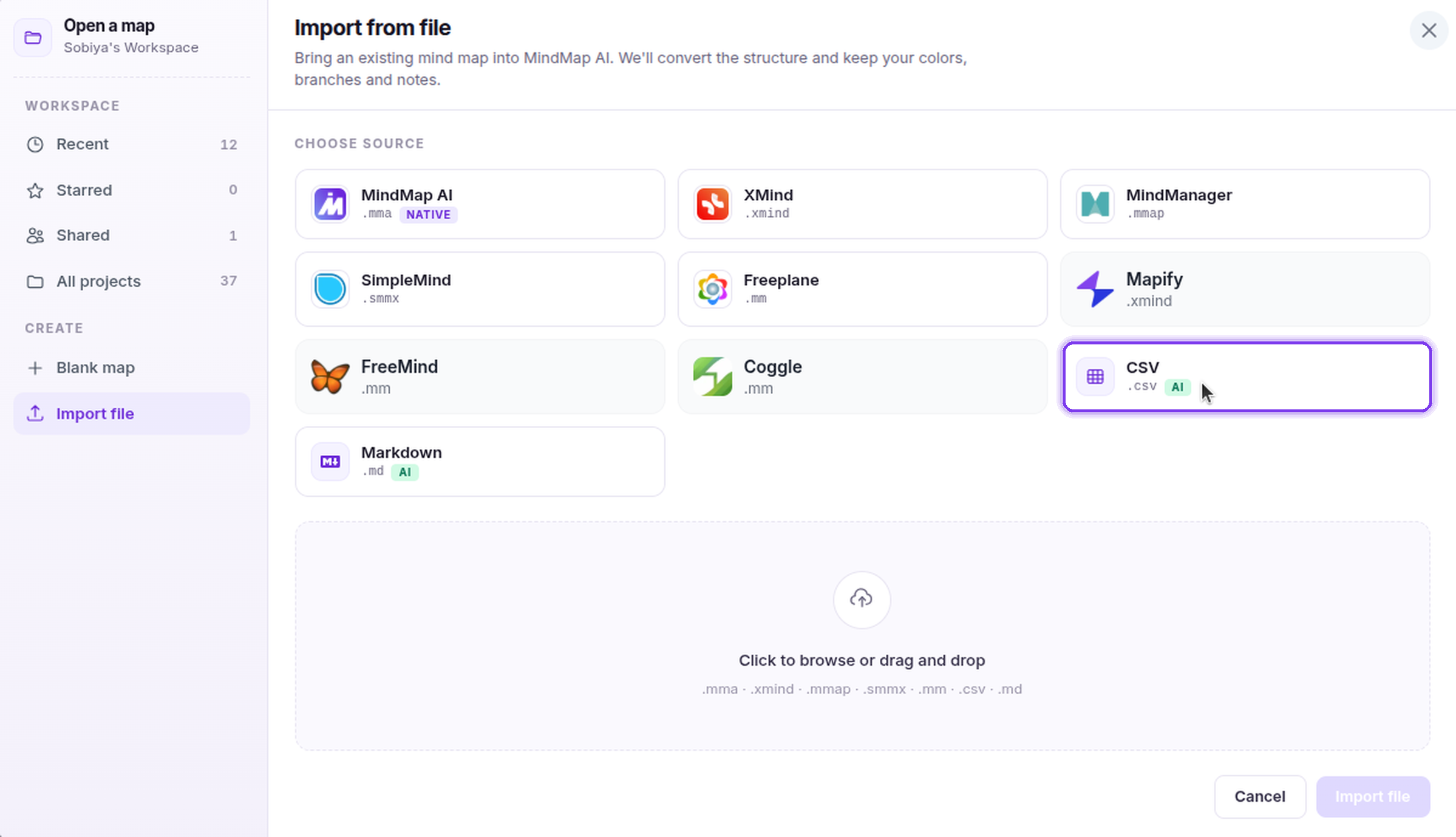
- The map opens on the canvas with your nodes and their branches in place, ready to edit.

What lands on the canvas is the map itself, not a picture of it: your nodes, their branches, and the text. Colors and images from the Miro board are not part of a CSV, so the new map takes MindMap AI's own styling.
The map is yours to work on from there, and it exports again to PNG, SVG, PDF, Markdown, or CSV whenever you need it somewhere else.
If you decide to move your mind mapping
If Miro is your team's whiteboard, this section is not for you. The canvas, the live collaboration, and the integrations are what Bending Spoons paid for. But if the mind map is the reason you open Miro at all, it is worth knowing what else is out there.
Tools that do nothing but mind mapping come in three broad types, and each one suits a different way of working.
- Desktop apps. XMind and MindManager keep your maps as files on your own disk and work offline. MindManager is the heavier, enterprise-oriented one, with close Microsoft integration.
- Browser tools built around sharing. MindMeister runs entirely in the browser with real-time co-editing. Coggle allows unlimited public diagrams on its free plan and keeps full version history, which suits fast shared brainstorms.
- AI-first tools. MindMap AI and others generate a map from a prompt, a document, or a file, then let you keep editing it.
Before you settle on any of these tools, check that it can import a CSV file. Many mind mapping tools read only their own format, which would leave your Miro export stuck in a spreadsheet. Our guide to Miro alternatives for mind mapping goes through the options in more detail, and there is a direct Miro vs MindMap AI comparison if you want the side-by-side.
What to do this week
- Export the maps you would mind losing. A few minutes each: an image or PDF to keep a record, a CSV if you want to keep working on the map.
- Open one of the files. Confirm the whole map came through, branches and all, while you still have the board in front of you to compare against.
- Note when your Miro plan renews. The deal is expected to close in the fourth quarter of 2026, and at Bending Spoons' earlier acquisitions pricing changes followed within about a year of closing.
FAQ
Nothing changes to your Miro mind maps right now. The deal is expected to close in the fourth quarter of 2026, and Miro operates on its own until then, so your boards, maps, and account stay exactly as they are. Worth knowing either way: unless you export them, your maps live only on Miro's boards. Miro can export a mind map as a CSV file, which keeps the text of your nodes and can be opened and edited in another tool. A change of owner is a sensible moment to keep your own copy of anything you would mind losing.
Bending Spoons is an Italian software company that buys established apps and runs them, rather than building new ones. Its purchases include Evernote in 2023, Meetup in January 2024, WeTransfer in July 2024, Brightcove and komoot in 2025, Vimeo in November 2025, and Airtable on 4 September 2026, six days before the Miro agreement. Across those deals the pattern has been the same: most of the acquired staff leave within weeks or months, prices or free-tier limits are revisited within about a year, and the product itself keeps running.
Open the board, open the Export this board menu, and choose the export you need. An image or PDF gives you a picture of the map. CSV gives you the map's text in a spreadsheet, which is the one to take if you want to keep working on the map somewhere else. Miro does not export OPML, .mm, or .xmind, so CSV is the format that moves between tools. MindMap AI reads that CSV with AI, working the hierarchy out from the columns, and rebuilds it as an editable map.
Miro has announced no pricing change, and nothing can change before the deal closes, which the companies expect in the fourth quarter of 2026. Nobody outside the two companies knows what comes after that, so the only guide is the record at Bending Spoons' earlier acquisitions. After Bending Spoons acquired Evernote, paid plan prices rose and the free plan was cut to 50 notes and one notebook in December 2023, including for existing free users. After WeTransfer, the free tier was capped at 10 transfers per month. komoot and Meetup also saw price increases.
No. Bending Spoons has agreed to buy Miro at an enterprise value of $1.355 billion, the deal is expected to close in the fourth quarter of 2026, and both companies operate independently until then. Bending Spoons says it intends to own Miro for the long term. None of the products it acquired earlier, including Evernote, WeTransfer, and Vimeo, was shut down. What changed at those products was staffing, pricing, and free-tier limits, not availability. Miro's integration plan has not been made public.
XMind and MindManager are the desktop options, MindMeister and Coggle the browser-based ones, and MindMap AI the AI-first one. Which fits depends on how you work: desktop apps keep your maps as files you own, browser tools are built around sharing, and AI-first tools generate and rework a map from a prompt or a document. Check that whichever you pick imports CSV, since that is the export a Miro mind map travels in. If your team needs the whiteboard rather than the maps, Miro itself is still the product for that.