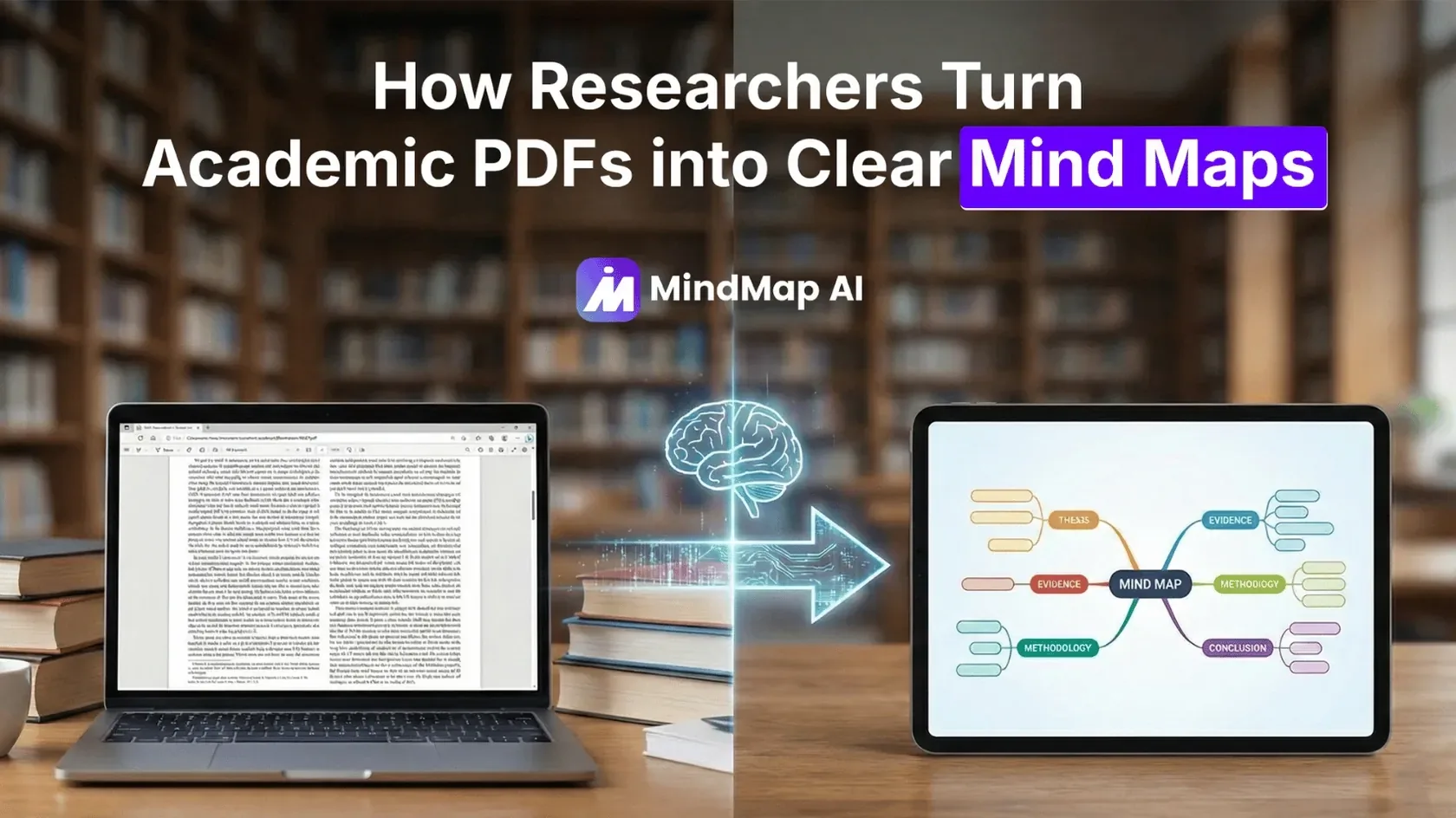
Academic research begins with reading but understanding does not always follow easily. Journal articles, conference papers, theses, and systematic reviews are usually delivered as long, dense PDFs filled with technical language, layered arguments, data tables, and references.
While this format is ideal for publishing and archiving, it is not ideal for quickly extracting structure, comparing studies, or synthesizing ideas across multiple papers.
Researchers often spend hours rereading the same document just to identify the core research question, methodology, findings, and limitations. When working on literature reviews or dissertations, managing dozens of PDFs becomes cognitively overwhelming.
This is why many researchers are turning to AI-powered mind mapping.
By converting academic PDFs into structured mind maps, researchers can visualize the architecture of a paper in minutes. Key arguments become branches. Supporting evidence becomes sub-branches. Methodologies, results, and gaps become instantly visible.
Instead of passively scrolling through text, researchers move to active, structured analysis.
In this guide, you'll learn how researchers convert academic PDFs into clear mind maps using AI, how this improves literature reviews and research synthesis, and how you can apply the same workflow to your own academic projects.

Why Academic PDFs Are Hard to Work With
Academic PDFs are designed for formal publication, not fast comprehension. Research papers follow structured formats abstract, introduction, methodology, results, discussion but when presented as long blocks of text, that structure becomes harder to see. Important ideas are spread across multiple sections, and key insights are often buried inside dense paragraphs.
Researchers commonly face challenges such as:
- Long, text heavy documents that require sustained concentration
- Complex arguments developed across multiple pages
- Difficulty comparing multiple studies side by side
- Repeated rereading just to extract the main points
- Hard to visualize relationships between theories, methods, and findings
When working on a literature review or research synthesis, these issues compound. Reading one paper is manageable. Reading twenty, fifty, or a hundred papers becomes cognitively exhausting.
PDFs preserve information, but they do not reveal structure at a glance.
This is why researchers increasingly look for ways to transform static academic PDFs into structured visual frameworks so they can move from passive reading to active analysis.
How AI Turns Academic PDFs into Mind Maps
When you upload an academic PDF, AI first extracts the text and detects the paper's structure (like abstract, introduction, methods, results, and discussion). It then identifies key ideas and organizes them into a hierarchy, turning main sections into branches and supporting points into sub-branches. Finally, it generates a clear, editable mind map so you can understand the paper's structure at a glance.
Step-by-Step: Turning a Research PDF into a Mind Map
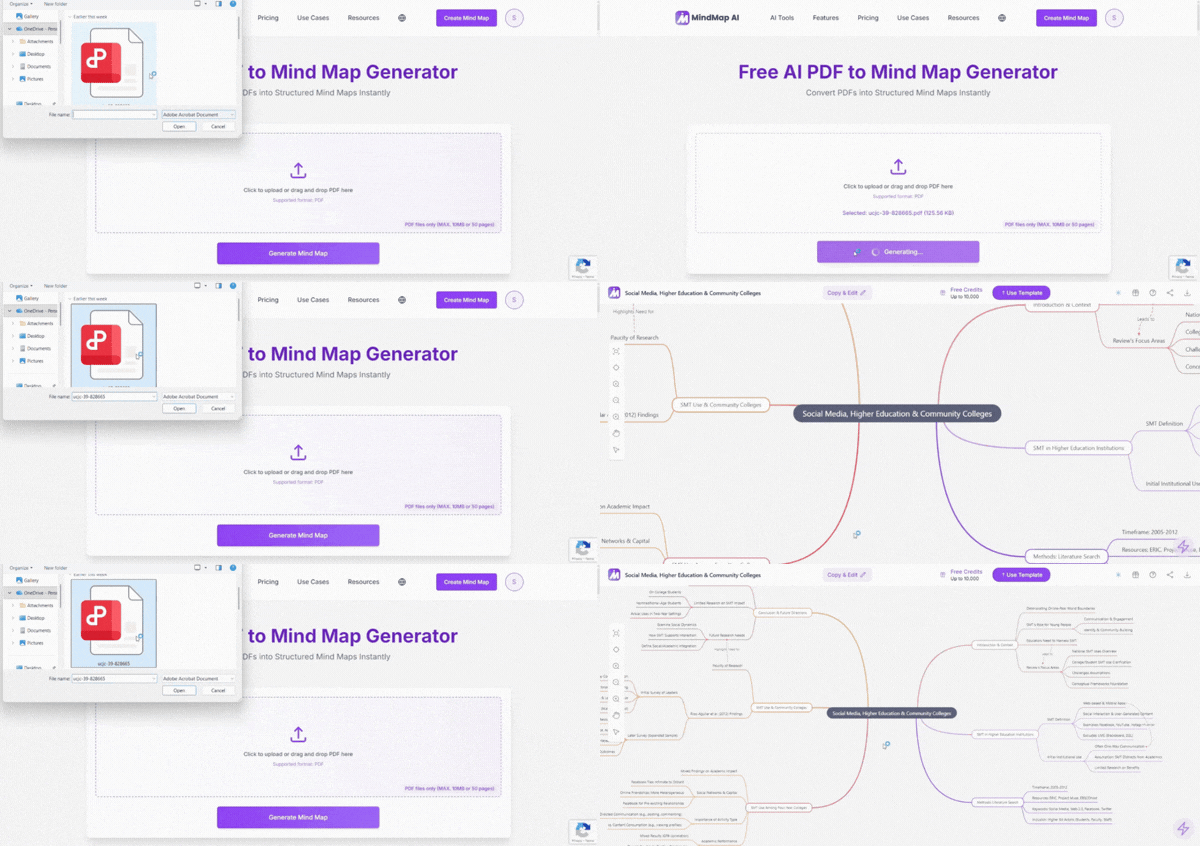
Reading long research PDFs can be overwhelming, especially when they contain complex arguments, data, and multiple sections. With MindMap AI, you can upload a research PDF and instantly convert it into a structured mind map for easier understanding and review.
Step 1: Upload Your Research PDF
Upload your PDF file directly to MindMap AI's PDF to Mind Map tool. The AI automatically analyzes headings, sections, and key points within the document.
Step 2: Generate the Mind Map
Once processed, MindMap AI creates a structured mind map that highlights main ideas, supporting arguments, and important concepts.
Step 3: Export or Share
After reviewing the mind map, download it as a PDF, image, or Markdown file, or share it via a link. This makes it easier to study, prepare presentations, or collaborate with peers.
How Researchers Use Mind Maps in Literature Reviews
Literature reviews require more than reading, they require comparison, synthesis, and pattern recognition across multiple studies. This is where mind maps become especially valuable.
Researchers use mind maps to:
- Compare findings across papers by placing similar themes under shared branches
- Identify research gaps by spotting missing connections or underexplored areas
- Group studies by methodology or theory for clearer thematic organization
- Track arguments and counterarguments within a topic
- Structure chapters before writing a thesis or dissertation
Instead of juggling dozens of PDFs, researchers can see the relationships between studies in one visual overview. A literature review mind map becomes a working research dashboard, something that grows and evolves as more papers are added.
PDF Text Summarization vs PDF Visual Summarization
| Feature / Focus | PDF Text Summarization | PDF Visual Summarization (Mind Map) |
|---|---|---|
| Output Format | Linear paragraph summary | Structured visual mind map |
| Structure Visibility | Limited, ideas appear in text form | Clear hierarchy with branches and sub-branches |
| Relationship Clarity | Connections must be inferred while reading | Relationships are visible at a glance |
| Comparison Across Papers | Difficult to compare side by side | Easy to compare themes and arguments visually |
| Cognitive Load | Requires rereading and scanning | Reduces overload with structured overview |
| Best For | Quick overview of key points | Deep analysis, synthesis, and literature reviews |
| Editing & Expansion | Usually static text | Editable and expandable structure |
Best Use Cases for Research PDF Mind Maps
AI-powered research mind maps are especially useful when you need to process large amounts of academic content quickly, without losing structure.
They work particularly well for:
- Master's and PhD students building literature reviews and thesis chapters
- Academic researchers reviewing large volumes of journal articles and conference papers
- Systematic review teams organizing studies by themes, outcomes, or methods
- Supervisors and lecturers guiding students through complex papers and arguments
- Policy and industry researchers synthesizing reports into clear insights and recommendations
Anywhere academic PDFs start piling up, mind maps bring clarity, structure, and faster understanding.
Common Challenges and How AI Helps
Research PDFs often slow down progress because of the complexity and volume of information. AI-based mind mapping reduces that friction by organizing content automatically.
- Dense academic language — AI focuses on structure and key ideas rather than difficult wording.
- Too many papers to manage — Mind maps make it easier to organize, compare, and synthesize studies visually.
- Time pressure — AI reduces manual reading, summarizing, and restructuring time dramatically.
By handling structure and organization, AI frees researchers to focus on analysis, synthesis, and critical thinking instead of repetitive note-making.
Tips for Better Research Mind Maps
AI can generate a strong structural foundation, but the quality of your research mind map improves significantly with thoughtful refinement. To make your research maps more useful and academically powerful:
- Start with well-formatted PDFs — Cleanly structured papers with clear headings produce better results.
- Rename branches for clarity — Adjust AI-generated labels to reflect precise research terminology.
- Use one mind map per paper first — Then create a master synthesis map to compare studies.
- Group papers by theme or methodology — This helps during literature review writing.
- Highlight research gaps visually — Add branches for limitations and future work.
- Avoid overloading the map — Expand only key findings, arguments, and methods.
AI builds the structure. Your academic judgment refines the insight.
Conclusion
Academic PDFs are built for publishing, not for rapid synthesis. When working on literature reviews, research proposals, or dissertations, reading alone is no longer enough. Researchers need structure, comparison, and clarity across multiple studies.
By converting academic PDFs into structured mind maps using AI, researchers move from passive reading to active analysis. Key arguments become visible. Methodologies can be compared instantly. Research gaps are easier to identify. Literature reviews become more organized and strategic.
Instead of getting lost in long, text heavy documents, you gain a visual overview of complex research in minutes.
FAQs
Yes. MindMap AI can turn academic PDFs into structured mind maps by detecting sections like abstract, methods, results, and conclusions, then organizing them into branches automatically.
Yes. MindMap AI can handle long academic PDFs. For very dense papers, you may get better clarity by converting one chapter or section at a time.
MindMap AI works well with journal articles, conference papers, theses, dissertations, literature reviews, whitepapers, and research reports.
If your PDF is image-based (scanned pages), text recognition (OCR) is needed. Text-based PDFs convert more accurately because the AI can read headings and structure clearly.
Yes. If you want a mind map for a specific section (like methodology or results), you can convert that part only by uploading the relevant pages or a split PDF.
Yes. MindMap AI supports multiple languages, so you can convert academic PDFs written in English and other major languages. Results are best when the PDF text is clear and well formatted.
Yes. Researchers use MindMap AI to organize papers by theme, compare findings, track methodologies, identify research gaps, and build structured literature review frameworks.
Yes. After converting your PDF, you can rename branches, reorganize structure, expand sections, and refine the map into a research-ready outline.