Why Concept Maps Matter
Concept maps are more than drawings, they're a way of thinking. Concept mapping helps you:

Simplify Complexity
Organize ideas into a clear structure.

Boost Memory
Connections make information stick.

Spot Insights
Reveal links you might miss in linear notes.

Communicate Clearly
Share knowledge in an instantly visual way.
What Is a Concept Map?
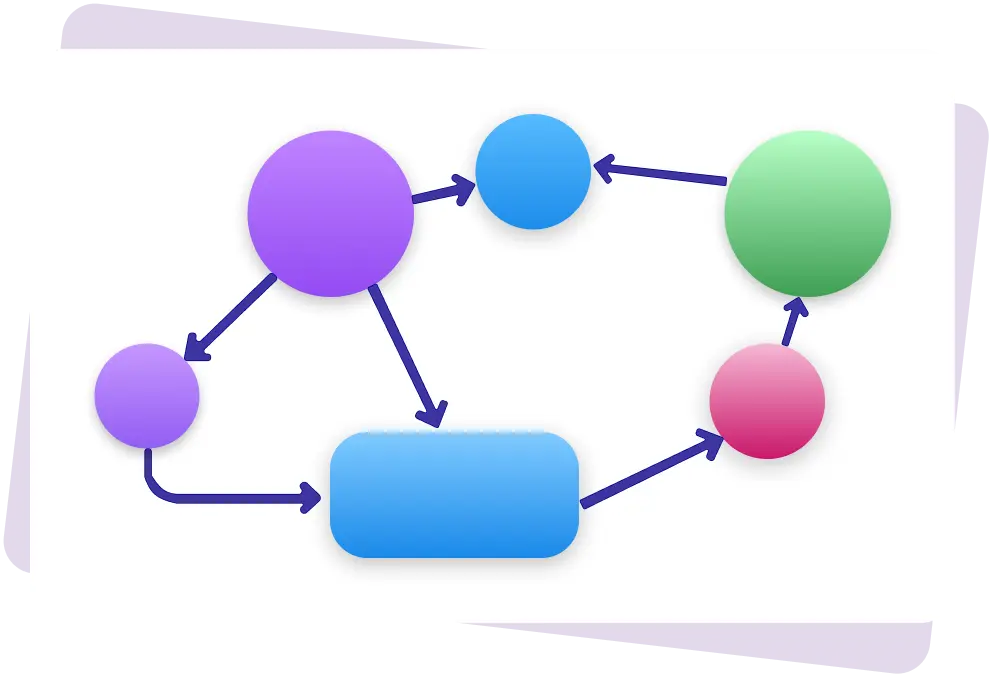
A concept map is a structured diagram that organizes ideas into nodes, usually represented as circles or boxes, and connects them with arrows labeled by short linking phrases. These labels clarify the nature of the relationships between concepts, transforming isolated pieces of information into a connected network of knowledge.
By presenting information this way, a concept map goes beyond simply listing terms or outlining points. It makes the relationships explicit, showing how one idea leads to, depends on, or influences another. This ability to display both content and context is what makes a map of concepts such a powerful tool for problem-solving.

How to Create a Concept Map Online
Creating a concept map online or on paper is simple:
Start With a Central Focus
Define the main question or topic you want to explore.
Identify the Key Ideas
Gather the most important concepts and supporting details.
Organize From Broad to Specific
Place general concepts at the top and arrange related details beneath them.
Connect Concepts With Linking Phrases
Use arrows and short words or phrases to explain relationships.
Highlight Cross-Connections
Show how different branches or sections relate to one another.
Concept Map vs. Mind Map
Both concept maps and mind maps are visual tools, but they serve different needs:

Concept Map

Hierarchical, structured, with labeled links. Best for learning and explaining knowledge.

Mind Map

Central idea with branches radiating outward. Best for brainstorming and planning.
If your goal is creativity and free-flow ideas, a mind map works better.
Applications of Concept Map

Education
Explain lessons, summarize research.

Business
Map project dependencies, workflows.

Healthcare
Organize patient data, care plans.

Science
Connect theories, experiments, and results.

Nursing
Structure diagnoses, interventions, and outcomes.
Frequently Asked Questions
A concept map is a diagram that organizes ideas into nodes and connects them with labeled arrows to show how concepts relate.
Concept mapping is used in education, business, science, and healthcare to simplify complex topics, improve understanding, and make learning more effective.
A concept map focuses on labeled, structured relationships between multiple ideas, while a mind map centers on a single idea and expands outward for brainstorming.
Concept mapping improves comprehension, supports critical thinking, strengthens memory retention, and provides a clear visual structure for complex information.
Students, teachers, professionals, researchers, and healthcare workers all benefit from using a map of concept diagrams to organize knowledge and communicate clearly.