Curriculum Mapping Made Simple With AI-Powered Mind Maps
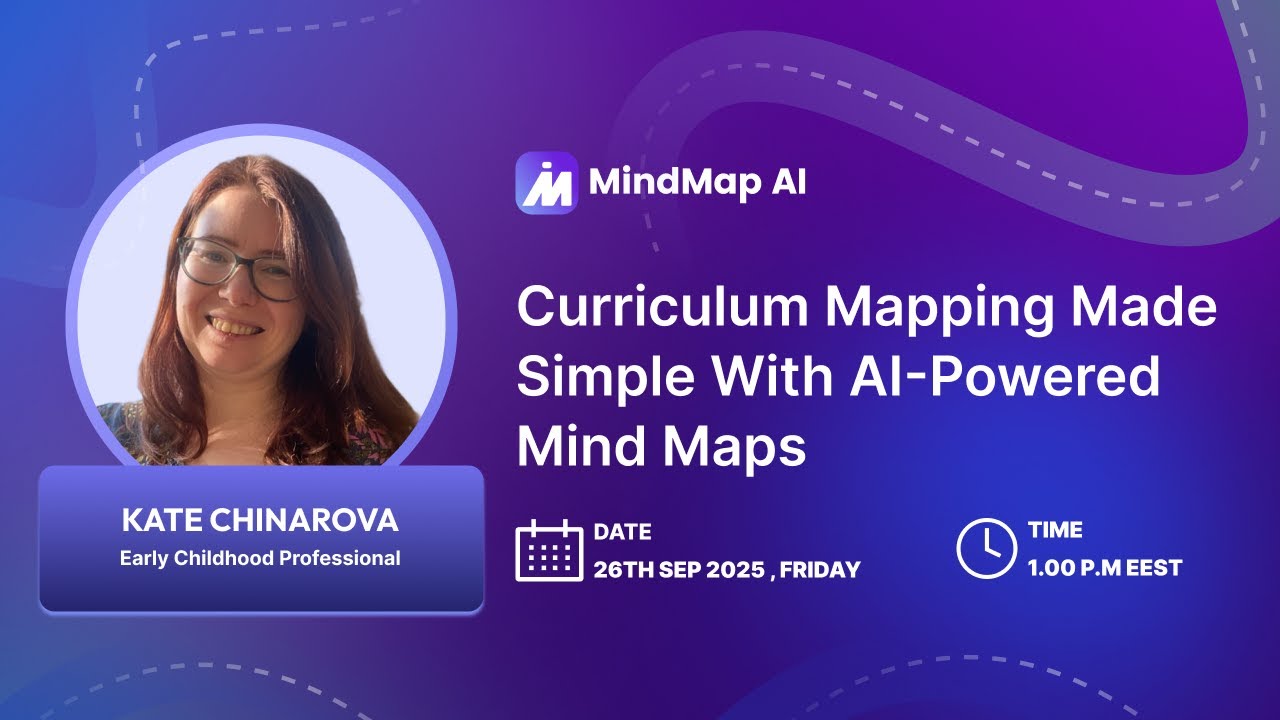
In this webinar hosted by MindMap AI, Kate Chinarova shares her journey from journalist to kindergarten teacher, and how mind mapping became her essential planning tool. She demonstrates how AI-powered mind maps help early childhood educators capture children’s voices, design play-based experiences, and collaborate effectively on curriculum planning.
Drawing from decades of experience, Kate explains how mind maps simplify one of the hardest parts of teaching, curriculum documentation. She shows how educators can use them to record observations in real time, expand children’s ideas into future learning opportunities, and embed cultural perspectives into everyday programs. Kate also highlights how MindMap AI transforms traditional planning. Instead of manually brainstorming activities, educators can now generate relevant ideas instantly, add images, and share maps across their teams. The result is a more engaging, collaborative, and flexible approach to early childhood education that benefits teachers, children, and families alike.
Why Mind Mapping Works for Early Childhood Planning
Captures children’s words and ideas as they happen.
Bridges reflective journaling with collaborative program design.
Aligns with play-based, emergent, open-ended learning styles.
Supports planning for children aged 3–5 who are not yet able to write.
4. Embedding Cultural and Environmental Perspectives
Include Aboriginal and Torres Strait Islander knowledge.
Connect local nature and sustainability practices to curriculum (e.g., gardening, bush tucker, excursions).
Key Takeaways from Kate Chinarova’s Webinar
1. Capture Children’s Voices
Mind maps allow educators to record children’s words and ideas in real time, turning them into a foundation for curriculum planning.
2. Support Play-Based Learning
Unlike rigid lesson plans, mind maps branch naturally from children’s interests into emerging learning opportunities.
3. Collaborative Curriculum Design
Mind maps can be shared digitally with teams, making planning more transparent and inclusive.
4. Integrate Culture & Environment
Kate shows how mind maps support embedding Aboriginal and Torres Strait Islander perspectives and sustainability practices into early childhood education.
5. AI as a Planning Partner
MindMap AI speeds up idea generation, suggests relevant activities, and allows easy integration of images, links, and documentation.
Frequently Asked Questions (FAQ)
1. How can mind maps be used with children who can’t read or write yet?
Mind maps serve as visual documentation tools. Educators can capture children’s words, experiences, and observations in branches, making learning visible without requiring literacy.
2. What makes mind mapping different from traditional lesson planning?
Lesson plans are linear, while mind maps allow branching based on children’s interests. This makes them ideal for play-based, open-ended curriculum planning.
3. Can MindMap AI be used collaboratively by teaching teams?
Yes. Educators can create and share digital mind maps across devices, ensuring all team members can contribute and adapt plans in real time.
4. How does AI enhance curriculum planning?
AI helps brainstorm new activities, expand on existing ideas, and provide cultural or environmental context, reducing manual research and saving educators time.