Every child learns differently, but dyslexic learners possess a particularly powerful gift: the ability to think in pictures, recognize patterns, and understand concepts through visualization. The challenge? Traditional education rarely taps into this natural strength.
But here's the question most parents struggle with: How do you transform this visual strength into academic success when most school systems still rely heavily on text-based learning?
Mind mapping isn't just another study technique, it's a visual learning strategy that aligns perfectly with how dyslexic learners think. Instead of forcing your child to adapt to linear, text-heavy methods, mind mapping works with their brain's natural preferences, turning visual thinking into a genuine learning advantage.
In this guide, you'll discover exactly how mind mapping supports dyslexic learners' visual strengths, practical strategies you can implement at home today, and real ways to help your child not just cope with learning challenges but truly thrive.
Whether your child is struggling with organization, memory, or simply staying engaged with schoolwork, mind mapping offers a path forward that feels natural, empowering, and effective.
Let's explore how you can make this work for your family.
What Makes Dyslexic Brains Different

Dyslexia affects how the brain processes written language, leading to challenges in decoding and reading fluency. However, dyslexic individuals excel in visual-spatial reasoning, creative problem-solving, and holistic thinking. This style of processing information through images rather than words is a genuine cognitive advantage linked to success in many creative and analytical fields.
Beyond their visual-spatial strengths, dyslexic individuals often possess exceptional abilities in pattern recognition, holistic thinking, and divergent creativity. They excel at seeing the "big picture," making connections that others might overlook and approaching problems from unique angles. This cognitive style supports innovative thinking and adaptability, which is why many dyslexics thrive as entrepreneurs, artists, engineers, and scientists.
Their capacity to process information in interconnected, multidimensional ways provides powerful advantages in fields that reward creativity, problem-solving, and out-of-the-box ideas. Viewing dyslexia as a difference rather than a deficit opens the door to appreciating these hidden intellectual gifts that contribute to success in many disciplines.
Why Visual Learning Works for Dyslexia
Mind mapping fits perfectly with dyslexic learners' preference for visual processing. Visual information is processed faster and more effectively by many dyslexics, and mind maps' nonlinear, associative structure naturally suits their thought processes, allowing them to make connections and build understanding in an intuitive way.
Visual learning helps dyslexic students by reducing the cognitive load required to decode and interpret text. When information is presented visually through images, colors, and spatial arrangements it bypasses some of the challenges dyslexic learners face with linear reading and phonetic processing. Research shows that visual attentional training and multimedia learning support faster processing and better comprehension for dyslexic individuals by strengthening their ability to focus on and extract meaning from visual cues. This approach allows dyslexic students to grasp concepts more efficiently and retain information longer, making learning less tiring and more effective overall.
Core Benefits of Mind Mapping for Dyslexic Learners
- Reduces reading load by using keywords, images, and colors instead of dense text, making learning less tiring.
- Uses spatial memory by placing information visually, helping students remember better than with traditional notes.
- Engages multiple senses (visual, kinesthetic, auditory) which strengthens memory and understanding.
- Helps organize thoughts and ideas visually, improving focus and reducing overwhelm.
- Breaks complex information into smaller, manageable parts for easier comprehension.
Practical Mind Mapping Strategies for Dyslexia

- Prioritize Images Over Text: "Show, don't tell" is the golden rule: use icons, symbols, and pictures instead of words wherever possible. This visual shorthand communicates ideas instantly while reducing the need to decode text. Developing a personal symbol dictionary helps learners build a consistent visual vocabulary.
- Strategic Use of Color Coding: Colors organize information without requiring reading skills. Assign consistent meanings to colors (e.g., red for conflicts, blue for ideas) to help dyslexic learners navigate their maps intuitively. Use color gradation to visually indicate importance and hierarchy.
- Minimize and Simplify Text: When text is necessary, keep it brief and clear: keywords, abbreviations, and dyslexia-friendly fonts like OpenDyslexic enhance readability. Prioritize clarity, increased font size, and ample spacing over stylistic concerns.
- Incorporate Radiant Branching Structures: Maps should mimic the brain's natural flow of ideas with curved, organic branches radiating from a central image. This associative pattern matches dyslexic thinking styles better than linear outlines and makes maps more engaging and memorable.
Subject-Specific Applications for Dyslexic Students
- Reading Comprehension and Literature: Mind mapping helps students activate prior knowledge, visualize story structures, and track characters and themes with images and minimal text. It transforms passive reading into an active, memorable process that aids understanding without overwhelming words.
- Mathematics and Problem-Solving: Visual breakdowns of word problems using symbols, flowcharts, and color-coded steps make math more accessible. Maps clarify relationships between concepts like fractions or formulas, helping students organize problem-solving procedures visually to reduce anxiety and cognitive overload.
How Parents Can Teach Their Child Using MindMap AI (Chat-Based & Visual Learning)
MindMap AI works differently from traditional mind mapping tools. It behaves more like ChatGPT, where parents and children can talk to the AI together, ask questions, and instantly see ideas turned into a visual mind map.
This makes it especially helpful for dyslexic and ADHD learners who understand better through conversation and images, not long written explanations.
Step 1: Start by Talking, Not Typing Perfect Instructions
Parents don't need special prompts or technical skills. Simply sit with your child and type something natural, such as:
- "Create a mind map about the solar system"
- "Help my child understand this story"
- "Turn this lesson into a visual mind map"

Step 2: Let MindMap AI Create the Mind Map Automatically
Once you send the message:
- MindMap AI instantly creates a structured visual mind map
- Main ideas appear as branches
- Related concepts are grouped clearly

Step 3: Use Images to Support Visual Understanding
For dyslexic learners, images matter more than text. Parents can:
- Upload images directly into the mind map
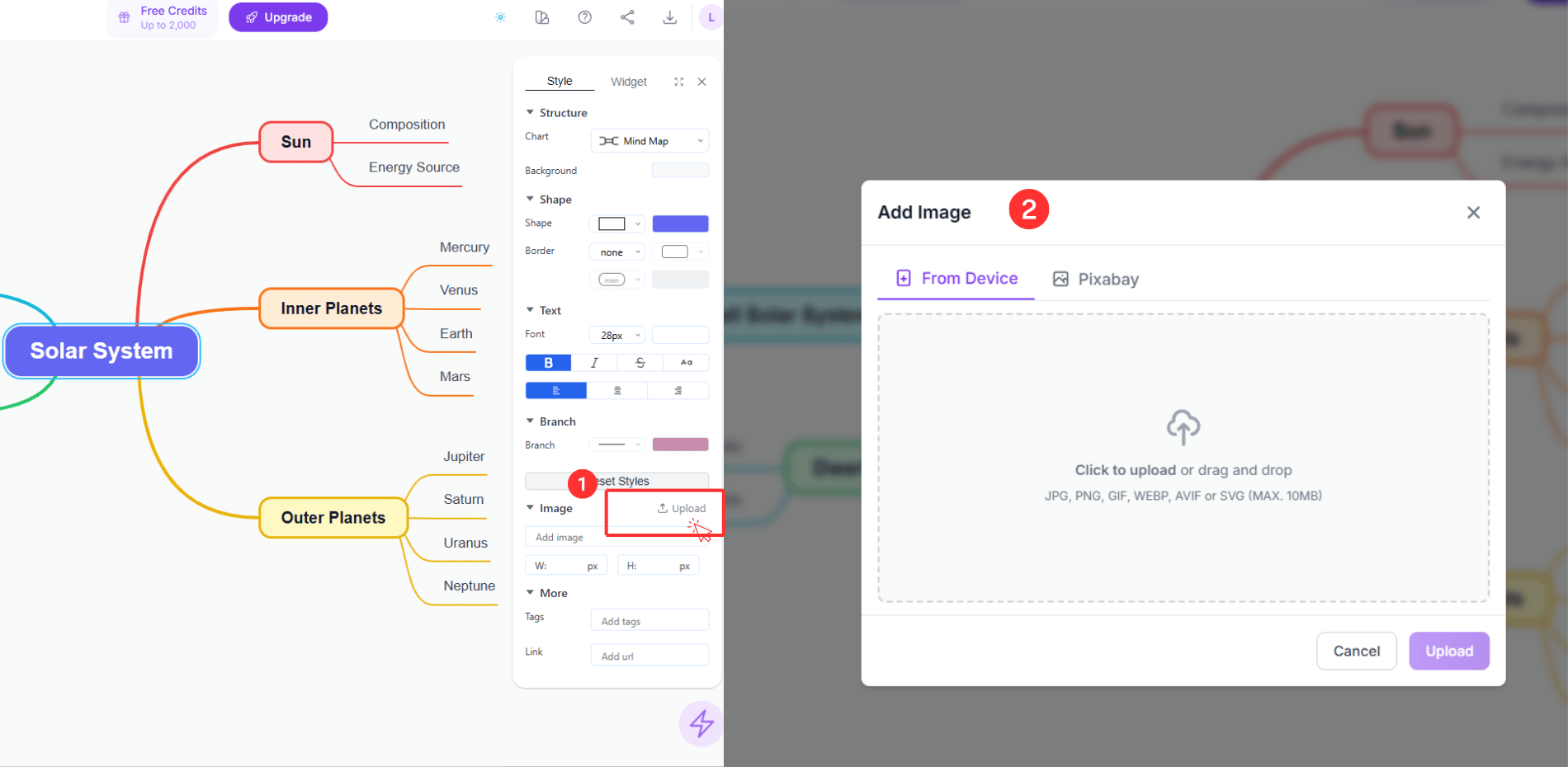
- Use simple pictures from free image sources like Pixabay
- Add visuals that match what the child already understands

For example:
- A picture of the sun for a science lesson
- A character image for a reading story
- Visual symbols for math concepts

Step 4: Teach Through Conversation Using the Mind Map
Parents can guide learning by talking through the map:
- "What do you think this picture means?"
- "Can you explain this branch in your own words?"
- "Should we add another image here?"
With MindMap AI, parents can also type:
- "Simplify this"
- "Add examples"
- "Explain this for a child"
The mind map updates automatically, keeping learning interactive and stress-free.
Step 5: Let the Child Learn One Visual Idea at a Time
Instead of overwhelming the child with too much information:
- Focus on one branch at a time
- Talk about the images first
- Add words only if needed
This supports attention, reduces frustration, and builds confidence.
Parent Reminder
You don't need to be a teacher. You don't need perfect explanations. By using MindMap AI like a visual conversation partner, you help your child learn in a way that feels natural, calm, and encouraging.
Why This Works So Well for Dyslexic & ADHD Learners
Dyslexic and ADHD learners are not lacking ability they simply process information differently. Traditional learning methods rely heavily on reading, writing, and linear thinking, which can create unnecessary barriers. A chat-based, visual mind mapping approach works because it aligns with how these learners naturally understand and retain information.
1. Learning starts with conversation, not writing
MindMap AI works like ChatGPT, allowing parents and children to talk their ideas into the tool. This removes the pressure to spell correctly, write full sentences, or organize thoughts upfront common challenges for dyslexic and ADHD learners.
2. Visual thinking replaces text-heavy learning
Images, icons, and spatial layouts communicate meaning instantly. Visual cues act as memory anchors, helping learners understand and recall concepts without decoding long blocks of text.
3. Reduces cognitive and working-memory overload
The AI automatically organizes ideas into clear branches, so learners don't have to hold everything in their head at once. This is especially important for ADHD learners who struggle with working memory and mental overload.
4. Supports non-linear thinking
Both dyslexic and ADHD brains tend to think in associations, patterns, and big-picture connections rather than straight lines. Mind maps mirror this thinking style, allowing ideas to grow naturally instead of forcing them into rigid lists.
5. One idea at a time improves focus
Parents and learners can explore a single branch at a time, preventing overwhelm. This "small visual steps" approach helps maintain attention and reduces frustration.
6. Builds confidence before skills
Because learners can understand the topic visually first, they approach reading or writing tasks with clarity and confidence. The mind map becomes a supportive guide rather than a reminder of struggle.
Conclusion
Dyslexic learners are not limited by their abilities; they simply experience and understand the world in a different way. When learning is presented primarily through text, their strengths can remain hidden. Mind mapping changes this by making ideas visible, connected, and meaningful, allowing children to learn in a way that aligns with how their brains naturally work.
By using mind maps and especially a visual, chat-based tool like MindMap AI parents can shift learning from frustration to clarity. Concepts become easier to understand, memory improves, and confidence grows as children see that they can learn effectively when information is presented visually.
Mind mapping is more than a study strategy. It is a supportive framework that helps dyslexic learners organize thoughts, express understanding, and approach learning with curiosity instead of fear. When parents embrace visual learning at home, they don't just help their child keep up they help them thrive, build independence, and recognize their own strengths.
With the right tools and approach, learning can finally feel natural, empowering, and enjoyable for dyslexic learners.