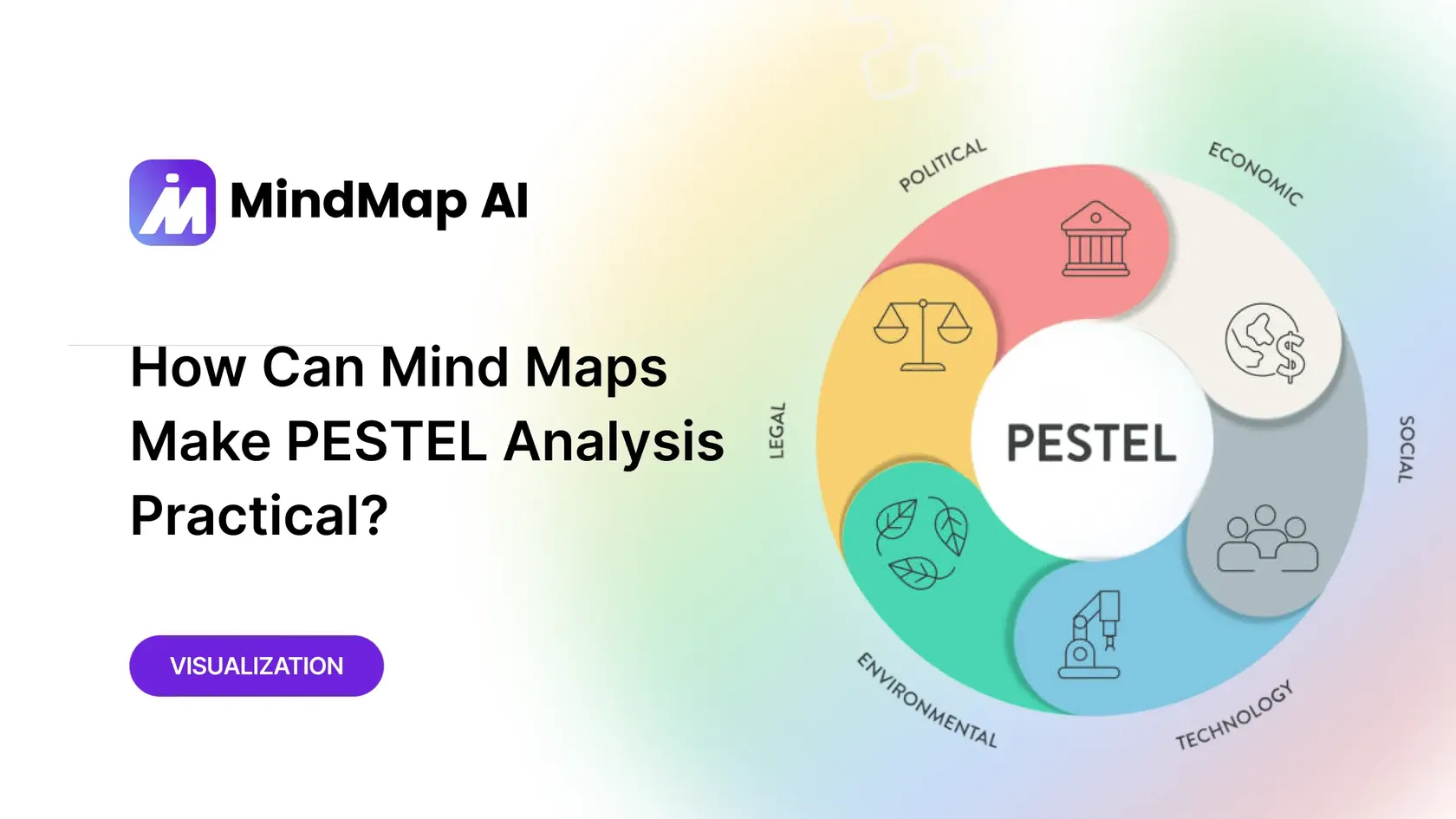
PESTEL analysis is a powerful way to understand the external environment shaping your organization. It examines Political, Economic, Social, Technological, Environmental, and Legal factors so you can anticipate opportunities and mitigate risks. Whether you're launching a product, entering a new market, or planning long-term growth, PESTEL aligns strategy with real-world forces.
The common failure point? Teams stop at listing factors and never link them to action. That's where mind mapping shines. With tools like MindMap AI, you can turn static lists into dynamic visual maps that reveal connections between forces and initiatives, so decisions move from theory to execution.
Understanding the Six Elements of PESTEL
- Political Factors: The Government's Hand in Your Business Government choices shape your playing field, tax policy, subsidies, procurement rules, trade agreements, labor law, and geopolitical risk. Supportive policy can speed growth (grants, R&D credits); restrictive policy can slow entry (tariffs, licensing).
- Economic Factors: The Financial Pulse of Your Market Economic forces include growth rates, inflation, interest rates, exchange rates, unemployment, consumer confidence, disposable income, and credit availability. They directly influence demand, pricing, costs, and investment timing.
- Social Factors: Understanding Audience and Culture Social factors reflect demographics, culture, values, lifestyles, and media influence. They shape preferences, buying behavior, labor availability, and ethical expectations.
- Technological Factors: Innovation and Disruption Technological factors are about the pace and direction of change, from automation and AI to connectivity, data, cybersecurity, and R&D. These create new products, disrupt incumbents, and alter cost curves.
- Environmental Factors: Sustainability and Responsibility Environmental factors include climate risk, resource scarcity, waste, pollution controls, and stakeholder pressure for transparency. Expectations around sustainability increasingly shape procurement and brand perception.
- Legal Factors: Navigating the Regulatory Landscape Legal factors are the binding rules for operating: consumer protection, data privacy, competition/antitrust, employment, health and safety, IP, and sector-specific laws.
How to Conduct an Effective PESTEL Analysis with MindMap AI
Step 1: You Describe Your Business
Start by describing your industry, market, or business focus. You can write a short instruction such as:
Try this prompt: "Create a PESTEL Analysis for the global renewable energy industry, highlighting key opportunities and risks in each category."
If you have market reports, PDFs, or data files, upload them, MindMap AI will extract and organize relevant insights automatically.

Step 2: View Your Structured PESTEL Map Instantly
In seconds, MindMap AI will generate a neatly structured mind map with six main branches, Political, Economic, Social, Technological, Legal, and Environmental. Each branch will contain summarized points representing the most influential factors in your business environment.

Step 3: Refine and Add Action Layers
Click on each branch to expand your analysis. You can:
- Add sub-nodes for Initiatives, Owners, KPIs, Milestones, or Risks
- Use Copilot Chat to summarize, expand, or simplify sections
- Ask the AI to identify interconnections (e.g., how "economic inflation" impacts "social spending")

Step 4: Share and Update with Your Team
Once complete, export your map as PDF, PNG, SVG, or Markdown, or share link. Your team can review it, suggest edits, and use it during planning meetings. Because MindMap AI stores your maps in the cloud, you can easily revisit and update them as market conditions change.

Why Use MindMap AI for PESTEL Analysis?
- Visual clarity: MindMap AI transforms complex PESTEL data into a clear visual map, showing how all six factors interconnect so you can spot the impact of any shift at a glance.
- AI-powered insights: The Copilot summarizes and distills complex environmental data into actionable points, cutting through the noise so you can focus on the trends and risks that matter most.
- Sharable and ready to present: Export as PNG, PDF, or Markdown, or share a live link so every department — strategy, product, marketing — stays aligned without lengthy email threads.
- Action-oriented: Add child nodes for Initiatives, Owners, KPIs, and Milestones directly under each external force so insights lead to assigned, trackable action rather than just discussion.
- Time-saving: Generate, edit, and refine your PESTEL analysis in minutes instead of hours. Upload reports, summarize data, and get a structured editable mind map instantly.
Diving Deeper: External Forces in Focus
PESTEL focuses entirely on external elements that influence your organization: By visualizing these together, you can prioritize which external trends deserve attention and design targeted responses.
- Political & Legal: compliance, stability, and guardrails Government priorities, elections, trade policies, labor rules, data privacy, IP, and sector-specific regulations set the boundaries for how you operate. Use this branch to flag upcoming bills, licensing needs, and compliance costs, then attach initiatives like "Update data retention policy," owners, and review dates. In MindMap AI, connect Political ↔ Legal nodes to see where policy shifts trigger legal obligations.
- Economic & Technological: growth levers and disruption risk Interest rates, inflation, currency swings, consumer spending, and funding conditions shape demand and pricing power. Meanwhile, AI, automation, cloud, and new standards reset cost structures and product roadmaps.
- Social & Environmental: brand trust and long-term license to operate Demographics, lifestyle shifts, values, and cultural expectations affect adoption and loyalty; climate risks, resource constraints, and ESG norms affect supply, resilience, and reputation. Capture signals like "youth preference for sustainable brands" or "heatwave-driven logistics risk," and translate them into action, supplier audits, greener packaging, community initiatives, with measurable outcomes.
Benefits of Using MindMap AI for PESTEL Analysis
- Comprehensive view: See all six PESTEL factors on one page. MindMap AI groups and color-codes branches so you can scan the full context at a glance, spot clusters, and avoid tunnel vision.
- Strategic alignment: Link external signals directly to internal goals and KPIs. Cross-link nodes to show cause→effect (Economic → Pricing, Legal → Compliance roadmap) so strategy and execution stay synchronized.
- Team engagement: Interactive maps turn planning into a shared workspace. Export to PDF/PNG/Markdown or share a link so leadership, product, marketing, and ops stay aligned without slide sprawl.
- Continuous adaptation: Markets move, your map should too. Update factors in minutes, keep version history, and run quarterly delta reviews to highlight what changed and which actions to start, stop, or continue.
- Decision clarity: Visual structure reduces noise and accelerates choices. Attach Initiatives, Owners, KPIs, Milestones, and Risks under each factor so trade-offs are explicit and decisions are faster, evidence-backed, and trackable.
Why PESTEL Often Falls Short Without Visualization
A common issue is treating PESTEL as a checklist. Teams list external factors but fail to link them to actionable steps. Without prioritization, it remains theoretical. Visual mapping bridges this gap, turning information into strategy by linking causes and effects.
Using MindMap AI, you can visualize how economic trends tie to policy risks or how social shifts align with technological opportunities. This helps your team move from awareness to action.
Beyond the Basics: Making PESTEL Actionable
PESTEL shouldn't end as an academic exercise. To make it truly impactful:
- Be specific about how each factor affects your business.
- Keep it dynamic, reviewing quarterly or annually.
- Combine with SWOT for internal–external balance.
- Assign ownership for each external risk or trend.
Key Takeaways
PESTEL analysis helps businesses anticipate external changes and adapt strategically. When visualized with MindMap AI, it becomes an actionable planning tool that aligns teams, identifies risks, and transforms environmental scanning into strategic execution.
By converting insights into actions, complete with KPIs, owners, and milestones, you turn uncertainty into opportunity and keep your strategy ahead of the curve.
FAQs
It helps businesses understand external macro-environmental factors affecting performance and strategy.
MindMap AI transforms text-based insights into visual, AI-enhanced mind maps for clarity and collaboration.
Prioritize the most influential trends, assign owners, and connect them to strategic initiatives or KPIs.
Yes, it's useful for career planning, market analysis, and personal decision-making.
Use MindMap AI to generate visual PESTEL diagrams, edit insights, and export them as strategy-ready reports.